 VapeWholesaleHub
Nicotine Payment Terms and Risk Management — Retail Chains
A nicotine programme fails in predictable ways: a specification nobody wrote down, a sample nobody retained, and a lead time nobody stress tested. Here is how to close those three gaps before they cost you a container.
Selling Nicotine at Store Level
Put nicotine where the decision is made, not where the margin is highest. In most stores that means near the counter or at eye level in the category, rather than wherever there is spare space.
Online, the listing for nicotine should answer three questions without scrolling: what it is, how strong it is, and what it tastes like. Everything else belongs further down the page.
Market Signals
One visible change in nicotine is the move towards clearer labelling and traceability. Retailers who adopted batch coding early are finding it much easier to work with larger distributors now.
How Nicotine Fits the Assortment
Category planning for nicotine works best when you map it against three shopper types: the restocker who already knows what they want, the switcher who wants something stronger, and the explorer who buys on flavour name alone.
Modelling a Healthy Margin
Margin on nicotine is rarely lost at the till. It is lost through dead stock, returns and emergency air freight. A slightly higher landed cost with predictable lead time usually beats the cheapest quote on the spreadsheet.
Watch the nicotine price you pay over a year rather than per order. Factories respond well to visible volume, and a quarterly review is usually worth more than a hard negotiation each time.
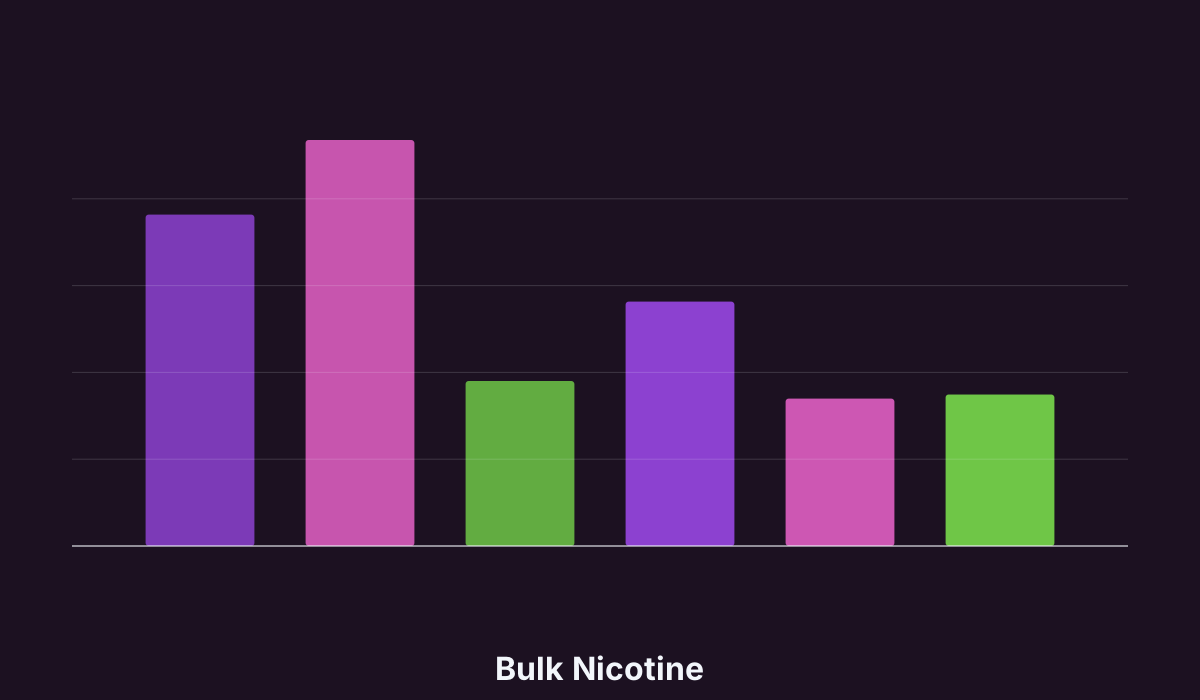
Indicative reference points for planning purposes: entry tier from USD 1.29 per unit at 2000 units, mid tier at USD 1.40, and volume tier at USD 1.29 for full container quantities. These figures move with specification, packaging and freight, so treat them as a shape rather than a quote.
Inspection Before Dispatch
The defect rate that matters is the one your customer experiences, not the one the factory reports. Bridge that gap by inspecting the way a customer would open the box, not the way a line worker packs it.
Most defects in nicotine are not dramatic. They are loose tolerances, a slightly thin seal, a mouthpiece that clicks. Left alone they turn into leak complaints, which are the single most common reason a retailer drops a line.
- Ask how the factory measures puff count, then compare like with like.
- Write the complaint threshold into the order terms.
- Plan the switch from air to sea freight before you need it.
- Agree the tolerance band in writing before approving artwork.
- Start with a mixed carton and let your own sell-through decide.
Practical Checklist
- Check carton dimensions against your freight quote before confirming.
- Model landed cost, not ex-works price, when comparing quotes.
- Agree the tolerance band in writing before approving artwork.
- Rotate stock by batch code rather than by delivery date.
- Start with a mixed carton and let your own sell-through decide.
- Keep sealed retained samples from every production batch.
Frequently Asked Questions
Is there support for in-store material?
Yes. Shelf talkers, counter cards and simple planogram suggestions are available for nicotine ranges that reach a sensible volume. Most retailers find the plain strength and flavour cards do the most work.
Can you match an existing product I already sell?
Often yes, provided we can measure it properly. Send a physical sample and we will report back on what can be matched, what will differ slightly, and why. An honest gap is more useful than a vague promise.
Do you hold stock for regular customers?
For established programmes we can reserve production slots and, in some cases, hold finished nicotine stock against a forecast. It removes most of the lead time risk from a reorder and is worth discussing once volumes are stable.
What happens if my market changes its rules?
Regulations move, and packaging or documentation sometimes has to follow. We keep approved artwork files on hand so that a required change is a reprint rather than a redesign, which keeps the cost and delay down.
Do you provide compliance documents?
Every shipment leaves with the documentation set relevant to your market, including batch records and test reports where required. Your local rules still determine what you must file, so confirm those with your broker before import.
Next Step
Start smaller than feels comfortable, measure honestly, then scale what worked. That sequence has saved more of our customers money than any negotiation tactic we could suggest.
Related Reading
- Nicotine Freight Forwarder Selection Notes — Cross-Border Trade
- Nicotine Mouthpiece Geometry and Comfort — Cross-Border Trade
- Nicotine Electronic Data Interchange for Large Accounts — Repeat Orders
- Nicotine Growing From Pallet to Container — Oceania
- Certification Routes for Nicotine in Different Markets — Online Sellers
- Nicotine Bundle Pricing That Moves Older Stock — High Volume Buyers